Guide
SIG #6 and #8 sights: what the numbers mean and which set your pistol takes
SIG sells P-series sights by number, and front and rear numbers run in opposite directions. Which pairing a 9mm, .40 or .45 SIG takes, and why.
Firearm Lab · PublishedSpec-and-fit analysis, not range-tested
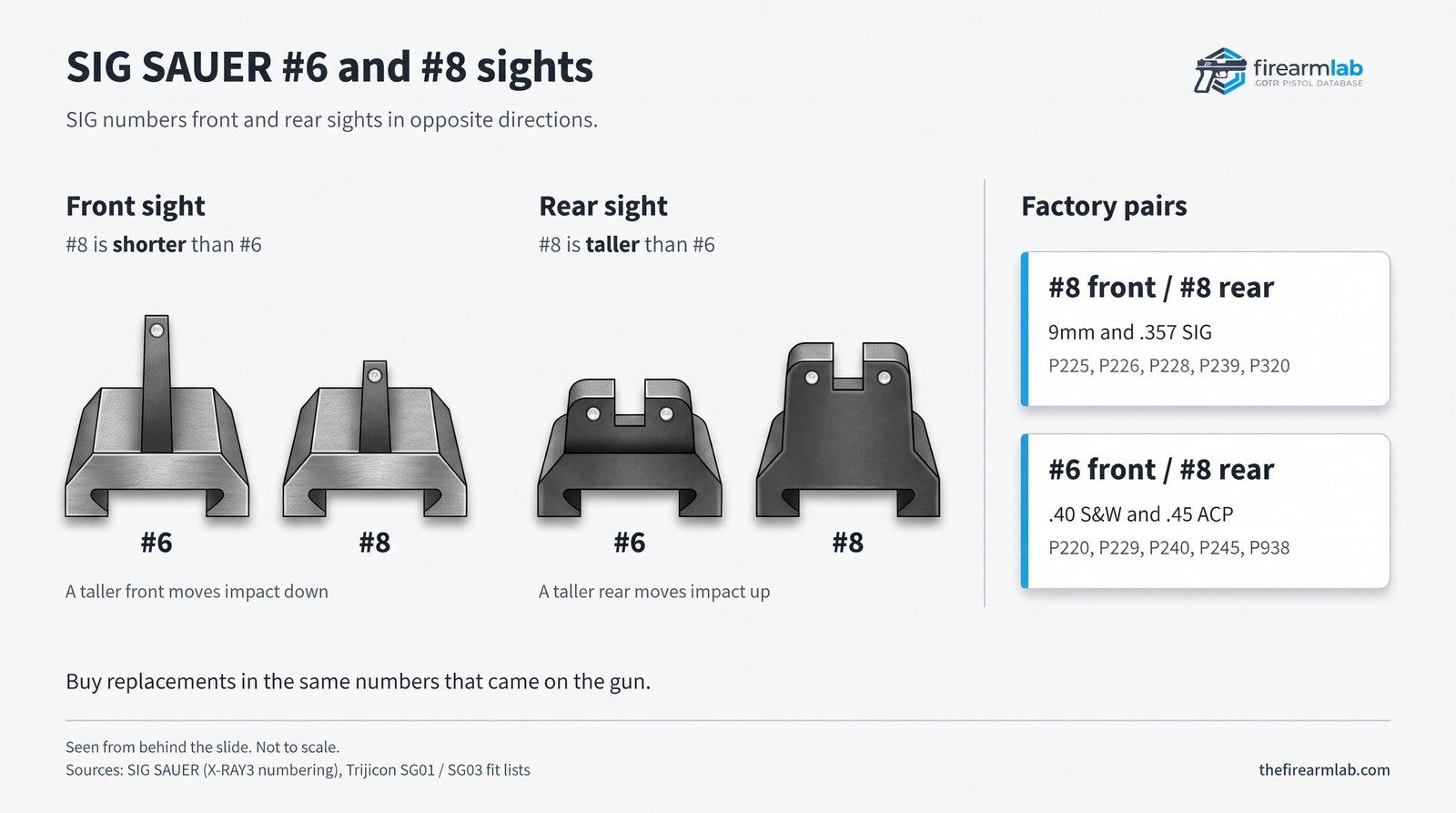
SIG sells its P-series sights by number rather than by pistol. Pull up a SIG sight set and you are asked whether you want #6 or #8, front and rear, and most people buying their first set of night sights have no idea what that means.
The numbers are heights, and they run in opposite directions for the front and the rear.
What the numbers mean
SIG's X-RAY3 page spells it out. For the front sight, "the higher the front size number (i.e. 6), the lower the height of the sight." For the rear, "the higher the number (i.e. 8), the higher the height of the sight." So a #6 front is taller than a #8 front, and a #8 rear is taller than a #6 rear.
SIG sells its X-RAY3 sets as #6/#6, #6/#8, #8/#6 and #8/#8 (front/rear). To find what is on your pistol now, SIG says to look at the small number on the horizontal bar on either side of the sight post. If you are happy with where the gun hits, buy the same combination you already have.
Which pistols take which pair
The factory pairing follows the caliber. Trijicon sells its SIG night sights in both pairings:
- #8 front / #8 rear: "Sig Sauer models calibrated for 9mm and .357SIG, including P225, P226, P228, P239, and P320 (Excluding P938 and P365)."
- #6 front / #8 rear: "Sig Sauer models calibrated for .40S&W and .45ACP": the P220, P229, P240, P245, P938, the Pro series and dovetail-sight P365s.
Trijicon lists the P229 only under the .40/.45 pairing. If yours is a 9mm P229, read the numbers on your sights before you order.
Why caliber changes the front sight
The heavier .40 and .45 guns get the taller #6 front. A pistol starts to recoil while the bullet is still in the barrel, and the muzzle rises before the bullet leaves. A slower, heavier bullet spends longer in the barrel, so the muzzle rises further and the gun prints higher. A taller front sight makes you hold the muzzle lower to line it up, which brings the shots back down. The 9mm and .357 SIG guns don't need as much correction, so they get the shorter #8 front.
So if you replace one sight with a different number, the gun will shoot to a different point.
What's in the catalogue
We list SIG sets in both pairings from Trijicon (Bright & Tough, HD, HD XR and fiber), Ameriglo (Classic Tritium, Custom Classic, Protector, Trooper, CAP, i-Dot and Ghost Ring) and Meprolight Tru-Dot, including Meprolight's #6/#6 set. The model pages link to the sets made for each pistol.
Our take
Read your numbers first. They're small, and on an old gun with worn finish you may need a flashlight held at an angle to see them. Then buy the same pairing unless you know why you want to change it. Change the pairing only if your gun shoots high or low with the ammunition you carry. If you are buying for a 9mm P226 or P320, it's #8/#8. A .45 P220 takes #6/#8. For anything else, or a used gun whose sights may already have been swapped, read the number on the sights you have.
Models in this post
- SIG SAUER P226 · 97 fits
- SIG SAUER P228 · 46 fits
- SIG SAUER P229 · 93 fits
- SIG SAUER P225 · 13 fits
- SIG SAUER P239 · 26 fits
Parts in this post
- Trijicon Bright & Tough™ Night Sights - for Sig Sauer® #8 Front / #8 Rear · 9 fits
- Trijicon Bright & Tough™ Night Sights - for Sig Sauer® #6 Front / #8 Rear · 8 fits
- Trijicon HD™ Night Sights - for Sig Sauer® #8 Front / #8 Rear · 9 fits
- Trijicon HD™ Night Sights - for Sig Sauer® #6 Front / #8 Rear · 8 fits
- Classic Tritium Sight Set for SIG Sauer® Pistols using a #8 front & #8 rear · 4 fits
- Classic Tritium Sight Set for SIG Sauer® Pistols using a #6 front & #8 rear · 4 fits
- MEPRO TRU-DOT® FIXED SIGHTS - SIG Dovetail, #8/#8 · 4 fits
- MEPRO TRU-DOT® FIXED SIGHTS - SIG dovetail, #6/#6 · 0 fits
Comments
Loading comments…