Guide
Ruger GP100 and SP101 front sights: plunger, dovetail or pin
Ruger used three ways to hold the front sight on the GP100 and SP101. How to tell which your revolver has before you buy a new front.
Firearm Lab · PublishedSpec-and-fit analysis, not range-tested
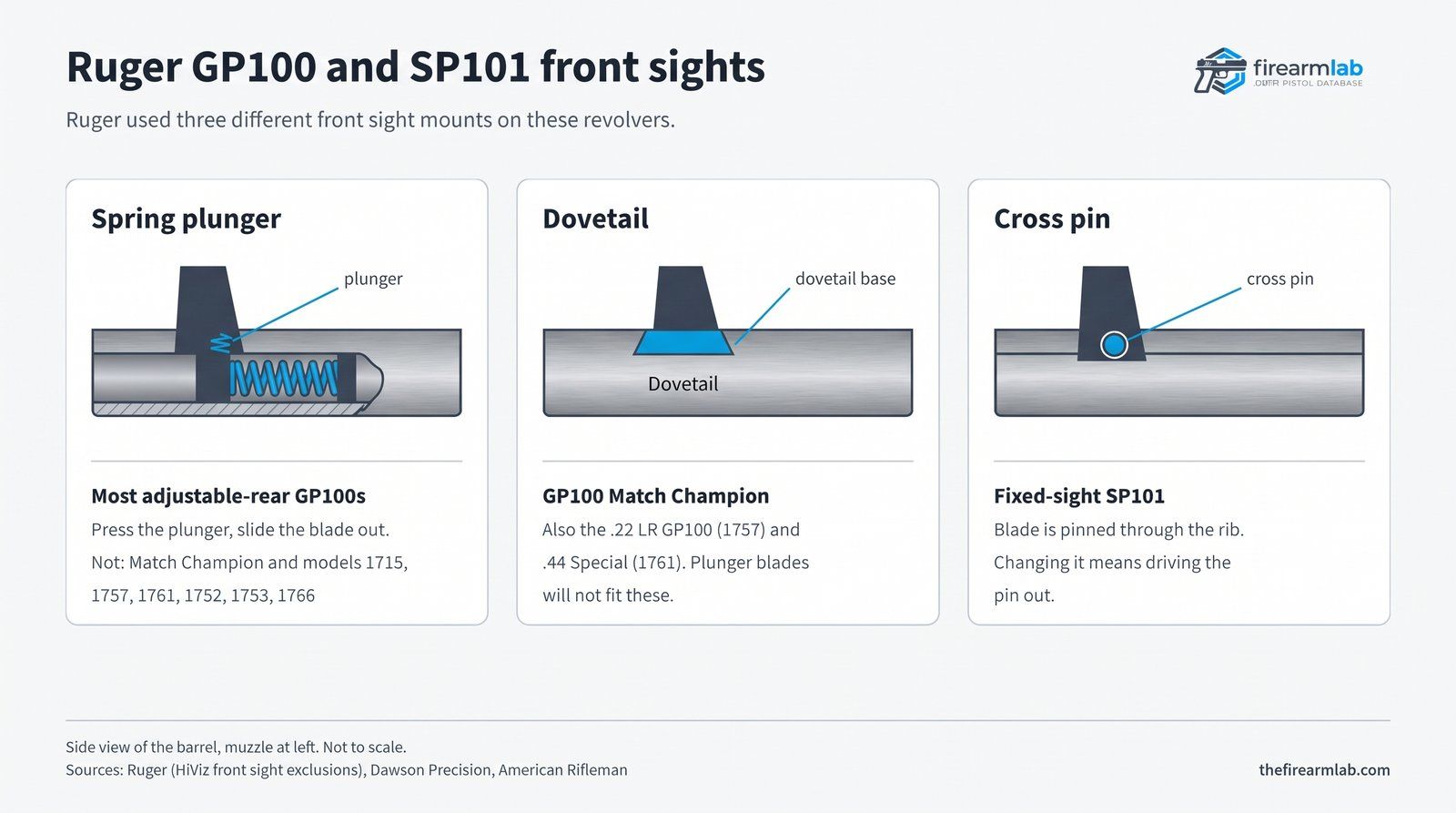
Ruger stopped building the GP100 and SP101 in October 2026, along with the LCR and Bearcat. The company told American Rifleman this "does not necessarily mean these product families are permanently discontinued," but for now no new ones are being made. A lot of owners will keep theirs running, and the front sight is the part most of them change.
Before you order one, find out how yours is held on. Ruger used three different methods across these two revolvers, and a sight made for one will not fit the others.
Spring plunger: most GP100s with an adjustable rear
On the standard adjustable-rear GP100, the front blade sits in a slot on the barrel rib and a spring-loaded plunger locks it there. Press the plunger and the blade slides out. Owners swapping in a HiViz blade describe pushing the button with a pin punch or a small Allen wrench.
Ruger's own HiViz replacement is sold "for Ruger GP100 revolvers with adjustable rear sight" and excludes the "GP100 Match Champion" and models 1715, 1757, 1761, 1752, 1753 and 1766. Find your Ruger model number (it's on the original box) and check it against that list.
Dawson Precision makes plunger-style fronts "DESIGNED FOR Ruger GP100 and Redhawk Series revolvers," in heights from .220" to .405".
Dovetail: Match Champion and some special models
The GP100 Match Champion uses a fiber-optic front dovetailed into the barrel rib. American Rifleman describes the same dovetailed front on the 10-shot .22 LR GP100 (model 1757) and a dovetailed fiber-optic front on the .44 Special (model 1761). Those models are on Ruger's exclusion list for plunger blades.
Dawson says plainly that its GP100 fronts will not fit these guns: "If you have a dovetail cut revolver model, you WILL NEED TO USE the Dawson Precision Novak Cut front sights." Neither Ruger nor Dawson publishes the dovetail dimensions, so stick to a front that is sold for the dovetail GP100 by name, or ask the maker before you buy.
Cross pin: fixed-sight SP101s
The fixed-sight SP101 uses a front blade held by a cross pin. Ruger sells one front sight for the "Ruger P-Series Firearms and SP101 models with pinned front sight" and notes it "Does not fit the SP101 models with dovetail front sight." So some SP101s, mostly the adjustable-rear fiber-optic versions, have a dovetail front instead.
A pinned front is more work than a plunger. The old pin has to be driven out, and a new blade may need its pin hole drilled to line up with the slide before the new pin goes in. That is usually a job for a gunsmith.
Front height sets elevation
On a fixed-sight revolver the front blade is the only elevation adjustment you have. A taller front moves the point of impact down and a shorter one moves it up. If your fixed-sight SP101 shoots low with your carry load, you need a shorter front. On an adjustable-rear GP100 you can correct with the rear, which is why front height matters less there.
What's in the catalogue
We now list the GP100 by front-sight type: the adjustable-rear plunger guns, the Match Champion, the .22 LR and the .44 Special, plus the pinned-front SP101. Each model page shows the fronts sold for that retention type, including the Dawson GP100 fronts and the Dawson Novak-cut fronts for the dovetail guns.
Our take
Look up your model number against Ruger's exclusion list before you buy anything. If it isn't on the list and the rear is adjustable, a plunger blade will fit. If it is on the list, or it's a Match Champion, you need a dovetail front. On a fixed-sight SP101, budget for a gunsmith to pin it.
Models in this post
- Ruger GP100 · 3 fits
- Ruger GP100 (adjustable rear, interchangeable front) · 2 fits
- Ruger GP100 Match Champion · 3 fits
- Ruger GP100 .22 LR · 3 fits
- Ruger GP100 .44 Special · 3 fits
- Ruger SP101 · 2 fits
- Ruger SP101 (pinned front sight) · 1 fit
Parts in this post
Sources
- American Rifleman: Ruger suspends production of several major models (Oct 14, 2026) ↗
- Ruger: HiViz GP100 front sight (fit and exclusions) ↗
- Ruger: P-Series and SP101 front sight ↗
- Dawson Precision: GP100 front sights ↗
- American Rifleman: Tested, Ruger GP100 10-shot .22 LR ↗
- American Rifleman: Tested, Ruger GP100 in .44 Special ↗
Comments
Loading comments…